
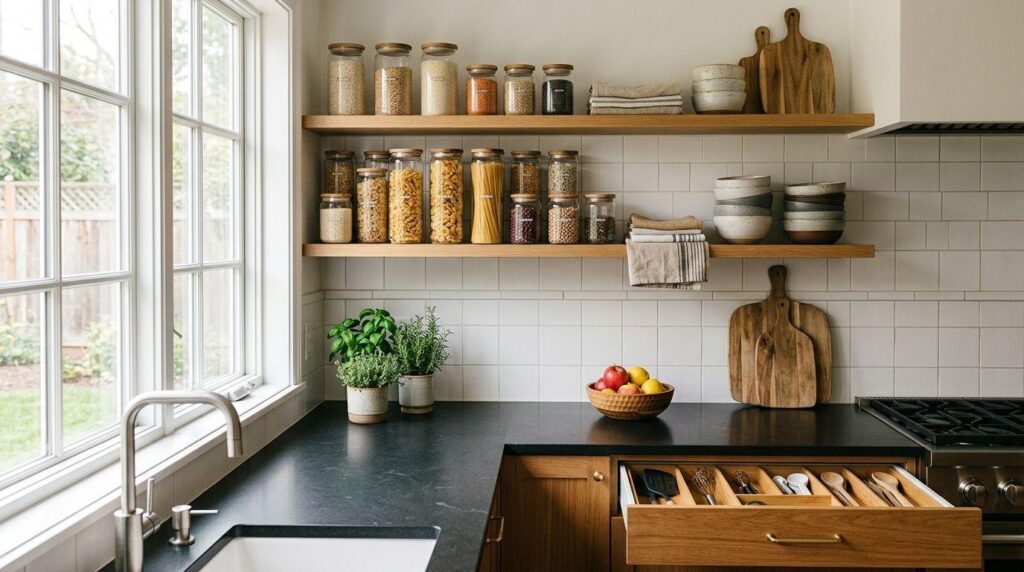
A cluttered kitchen rarely feels like just a cleaning problem. For many households, it quietly shapes the mood of the entire evening, from the moment someone opens the fridge to the last dish put away. Thoughtful kitchen storage organization is less about tidiness for its own sake and more about removing small daily frictions that add up over a week. When food, tools, and containers have a clear, visible place, decisions happen faster and tempers stay calmer, especially during the rushed window before dinner. This article looks at why disorganized kitchens create background stress, what habits actually hold up over time, and how visible, accessible storage, including freezer drawers designed for a quick overview, can support a smoother family routine without turning organization into another chore on the list.
TL;DR — Key Takeaways
Why Kitchen Chaos Quietly Drains Family Energy
A messy kitchen taxes the brain in a way that is easy to underestimate. Every time someone has to search three cabinets for a measuring cup or dig through a freezer to find a forgotten bag of vegetables, that person spends a small amount of mental energy on a decision that should not require any thought at all. Psychologists sometimes describe this pattern as decision fatigue: the cumulative effect of making many small choices in a short span. In a kitchen, that fatigue shows up as short tempers over what to cook, frustration when a needed item cannot be found, and a general sense that the space works against the people using it rather than for them.
Visual clutter adds a second, quieter layer of stress. Even when no active task is happening, a counter covered in mismatched containers or a pantry with items facing every direction keeps the eyes scanning and the mind mildly alert. This background stress rarely announces itself directly; it tends to surface as irritability or a vague feeling of being overwhelmed at the end of a long day. Recognizing that the kitchen’s physical layout can contribute to this state is the first step toward treating storage decisions as something closer to household well-being than to housekeeping.
Small Organizational Habits That Create Daily Calm
Long-term calm in a kitchen comes less from a single big overhaul and more from a handful of small habits repeated consistently. One of the most effective is assigning designated zones for categories of food and tools rather than letting items land wherever there is space. When baking supplies always live in one area, snacks in another, and frozen staples in a predictable spot, every family member builds a mental map of the kitchen over time. That map removes the need to ask or search, which is precisely where much of the daily friction disappears.
A second habit worth building is a short weekly reset. Rather than waiting for clutter to accumulate into a larger project, a brief walkthrough once a week, returning stray items to their zones, checking what has expired, and noting what is running low, keeps the system from sliding back into disorder. This works because it treats organization as maintenance rather than restoration; a five-minute check is far less draining than an occasional deep reorganization that feels like starting over each time.
These habits work together in a specific order:
None of these steps require special equipment. What they require is consistency, since the benefit compounds only when the habit becomes automatic rather than an occasional effort.
Storage Systems That Make Food Visible and Accessible
Habits matter, but they work best when the storage itself supports quick recognition rather than working against it. This is especially true for freezers, where deep drawers and stacked bags can turn “what do we have” into a genuine mystery. Storage that lets a person see contents without pulling every drawer open removes one of the most common sources of small daily friction in meal planning.
Some fully integrated freezer models address this directly by using drawers with transparent fronts, so the general shape and quantity of what is stored becomes visible at a glance instead of requiring a full inspection. This matters more than it might first appear: a quick glance that confirms there are still vegetables or a meal prepped for later removes a small decision point from an already busy moment. Combined with designated zones inside the freezer itself, such as one drawer for proteins and another for ready meals, visibility and habit reinforce each other rather than working separately.
Physical ease of use plays a role too. The integrated Freezer 60 / 40 relies on telescopic rails that let drawers glide out smoothly even when fully loaded, which reduces the physical effort of reaching deep into a packed compartment. For households that reorganize their freezer often, this can determine whether a system stays maintained or slowly falls apart because retrieving items feels like more trouble than it is worth. A well-organized freezer only stays organized if using it is actually easy, so drawers that open smoothly and show their contents at a glance make the difference between a system that lasts and one that quietly reverts to chaos within a few weeks.
Involving the Whole Family in Keeping Order
An organized kitchen rarely stays that way if one person is solely responsible for maintaining it. Assigning simple, visible tasks to children and other household members turns storage systems from a personal project into a shared routine. A task is easier to sustain when it is concrete and immediately checkable, such as “frozen vegetables go in the left drawer” rather than a vague instruction to “help keep things tidy.” Visible tasks also give younger children a sense of contribution without requiring judgment calls they are not ready to make.
Shared routines build cooperation more effectively than one-time instructions. When unpacking groceries, resetting the pantry, or checking the freezer becomes a predictable moment that happens the same way each week, family members start to participate without being asked, simply because the pattern is familiar. This mirrors how habits form in any part of a household: repetition in a consistent context, rather than reminders, is what eventually makes a behavior automatic.
It also helps to revisit assignments as family needs shift. A task that suited a young child may need adjusting as they grow, and a system built around a smaller household may need new zones once shopping patterns or family size change. Treating the kitchen’s organization as a living system, rather than a one-time fix, keeps it functional through these transitions instead of quietly breaking down and reverting to clutter.
Frequently Asked Questions (FAQ)
How often should kitchen storage be reorganized?
There is no fixed schedule that works for every household. A short weekly reset tends to prevent major drift, while a deeper look at zones and categories makes sense whenever shopping habits, family size, or routines change noticeably.
Do organization habits differ for small versus large families?
The underlying principles, such as visible zones and shared routines, apply regardless of household size. Larger families often benefit from more clearly separated zones and more explicit task assignments, simply because more people are interacting with the same storage space each day.
Is visible storage really worth prioritizing over just decluttering?
Decluttering and visibility work together rather than competing. Removing excess items reduces the amount to organize, but storage that allows a quick glance at contents is what keeps the space functional day to day, long after the initial decluttering effort is done.